Practice your English in context. Learn. Read. Listen. Pronounce. Play games...
Showing posts with label Articles. Show all posts

Monday, 10 June 2019

PREPOSITION 'ON' + DAYS & DATES


Basic: preposition ON + day of week or date, but with no article.

Tuesday, 5 February 2019

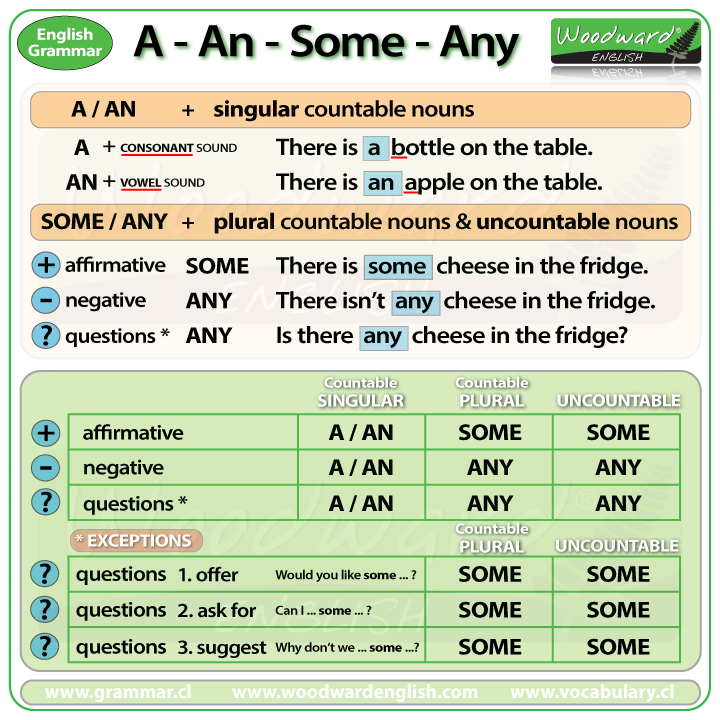
SPELLING ARTICLE 'A(N)': RULE & EXCEPTION

This chart shows the rule to spell the article 'A' or 'AN' and the exception.

Friday, 18 May 2018

USE OF ARTICLE BASIC CHART


Posting today a basic chart about the use of articles in English, together with a practice exercise. All from the British Council web.
All about articles & determiners on this blog in this link: HERE.

Sunday, 7 January 2018

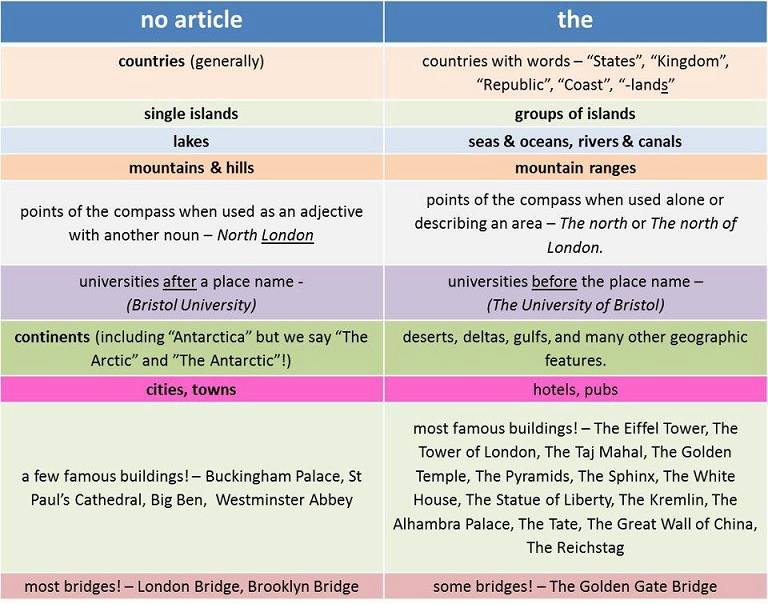
ARTICLE 'THE'+GEOGRAPHICAL NAMES


Chart showing the use of article 'THE' before geographical names.
More on the use of articles on previous posts here:

Tuesday, 27 September 2016

USE OF ARTICLES A(N), THE


A and An =  indefinite articles (not a specific object; not everyone knows what you’re talking about)
  • Eric has a dog.
  • I’d like an apple.
  • She works at a school.
The= definite article (a specific object that both the person speaking AND the listener know)
  • The dog that lives next door is nice.
  • I’d like the apple that is sitting on the table.
  • She works at the school where my children go.
More on the use of article 'THE', HERE.
A few basic rules:
  • The first time you speak of something, use  A or An.  The next time you repeat that object, use The.
I saw a mouse in my house.  The mouse was trying to run behind my refrigerator. 
We saw a movie last night.  We invited my friend to the movie, but she couldn’t join us. 
  • DO NOT use an article with names of countries, states, cities, counties, lakes, sounds, falls, or mountains, EXCEPT when it’s a collection of states (such as the United States) or collection of mountains/lakes (the Cascade Mountains, the Great Lakes)
               I live in Bellevue, near Lake Washington. (NO articles)
               She lives in Issaquah, near the Cascade Mountains, close to Lake Sammamish.
               My son hiked Mt. Rainier last summer. (NO article)
  • DO use a definite article with oceans, seas, and rivers.
               He lives near the Baltic Sea.
               We visited the Snoqualmie River.
  • DO NOT use an article when speaking about things in general.
               I like Turkish tea.
              Jonny likes reading books about whales.
  • When talking about schools or colleges, we generally DO NOT use an article (Bellevue College, Seattle University, Clyde Hill Elementary)  EXCEPT when the word College, University, or School comes FIRST (The University of Washington, The College of Connecticut, The School of Teaching ESL).
  • We generally DO use a definite article for places/building that we generally know, such as the library, the mall, the grocery store, the bank, the post office.
  • DO use a definite article when talking about superlatives (the most delicious cake, the longest road)
Exercise: Check this text for the correct use of articles:
See correction to this exercise practice in this LINK.

Friday, 4 December 2015

USE OF ARTICLE 'THE'


Here's a chart with the always confusing uses of article 'THE', which don't always coincide with Spanish. Remember that there's also the ZERO article possibility, already seen in a previous post HERE.


Thursday, 26 February 2015

REVIEWING: 8 MISTAKES YOU SHOULDN'T DO

Here's a list of mistakes you should try to avoid:

8 Mistakes You Must Correct:

  1. 1

    Problems with Subject-Verb Agreement

    Some of the most painful things teachers have to hear are “she have”, “he don’t” or “people doesn’t”. Ouch! This is such a typical mistake. Because this is something you repeat and are used to repeating, you may “listen” to our correction but often don’t take the time to really let it sink in. If you are students who make the same subject-verb agreement mistakes, take the time to stop and really pay attention to it.
  2. 2

    Incorrect Verb Tenses

    These mistakes crop up again and again. If there’s one thing students need to focus on as they review for a test is the tenses they’ve learned, whether they are simple or advanced. Help by providing plenty of comparative charts – graphic organizers or timelines.
  3. 3

    Missing or Extra Articles

    Some students add an extra “the” when they shouldn’t (“The children play the Angry Birds.”) or omit an article that should be there (“I ate piece of toast for breakfast”). If you make lots of mistakes with articles, be sure to get a good review.
  4. 4

    Repetitive Use of False Friends

    Lots of languages, if not all, have “false friends” with the English language. For example,embarazada means “pregnant” in Spanish not “embarrassed” (and this confusion can make for some pretty funny classroom situations). There are examples like this one in many other languages. If you are students who resort to false friends, or even like to make up words, no matter how funny it may seem, you should try to use words you are sure are correct because you’ve learned them.
  5. 5

    Pronunciation of Silent Consonants

    If you have students who still pronounce the silent b in “comb” or “bomb”, you need to take a minute to write these down on the board and show them exactly which letters they need topronounce. The same goes for words like “Wednesday” (when the student pronounces the first d) or “muscle” (when the student pronounces the c as a “k”).
  6. 6

    Speaking through Literal Translations

    Everything seems to be going well in your classroom. Your students are very attentive and no one is speaking their native language. But then someone says, “I have 20 years.” If you, like this student, are also a native Spanish speaker, you’ll know for a fact your student just did a literal translation in his/her head. Students will do this, you can be certain of that, but it’s something you need to correct right away, lest they keep doing it.
  7. 7

    Wrong Prepositions

    This is one of the hardest mistakes to correct. There are so many uses for so many different prepositions, it’s hard for students to keep track of them all. One of the best ways to help out students who perpetually use the wrong preposition is to organize them into contexts, for example prepositions of place. We say we are “at school”, “at work”, “at home”, but “in the living room”, “in the bedroom” (“in” a particular room). We may also point out the difference between saying “at the bank” (in a bankingsituation) and “in the bank” (literally inside the building as opposed to outside).
  8. 8

    Countable/Uncountable Mix-ups

    Students in all levels will get countables and uncountables mixed up and incorrectly use “a little”, “a few”, “many”, “much”, etc… Again, charts and graphics are very helpful in this case, to help students see exactly what they’re doing wrong. You can use the classic two-column list to contrast (“a few cars” vs. “a little traffic”) or any of these strategies.

Wednesday, 25 February 2015

ZERO ARTICLE


We say ZERO ARTICLE when no article is needed. Many mistakes are made using the article when it's not needed, Below when we don't need one:

Below a chart where you can see examples of when ZERO ARTICLE is used:

Compare in the chart below when to use ZERO ARTICLE and ARTICLE THE:

This site is used with a non-profit educational purpose only. If you find content (photo/video...) you think shouldn't have been included here, please tell me so I can delete it. Thanks.

Blog labels / Tabs

'-ED' '-ING' 'S 1ºBac 1ºESO 2ºBac 2ºESO 3ºESO 4ºESO 8M A(N) ABAU AS Abbreviations Ability Accents Adjectives Ads Adverbs Advicing Agreeing Agreement Alphabet Altkönigschule Animals Animation Anniversaries Antonyms Apologizing Apostrophe AprilFool Art Articles Aux.Verbs BBC BE BY Basics Behaviour Biography Blog Body BonfireNight BrE/AmE Bullying Business CINEMA COVID CV CW Carnival Causative Cause Celebration Christmas Cities CitySongs ClassActivity ClassrooManagement ClassroomLanguage Clothes Collocations Colours Commitment Communicating Comparatives Competition Compounds Conditionals Confusing Connectors ContinuousTenses Contractions Contrast ConversationAssist Cooking Coruña Cosmos Countability Crime Culture Curiosities DO Date Day Deduction Demonstratives Descriptions Design Determiners Directions ENOUGH EW19 Easter Emails Emphasis EngDepActivities EngEvolution EnglishWeek Environment Exams Exclamations F&AEssay FalseFriends Family Feelings Films Flashback Food Football Formal FrequencyAdvs Fun Functions Furniture Future GET GO Galicia Game Gastronomy Gender Genitive Geography Graduation Grammar Greetings Greta HAD BETTER HAVE Halloween HandwritingHistory Harassment Health Help tips Heritage History Home Homecoming Homographs Homophones Horoscopes Hull HumanRights Hygiene ICT Idioms Imperative Infinitive Info Informal Instruments Interjections Internet Introducing Inviting Ireland IrregularVerbs Jobs Karaoke Kron19 Kron23 Kron25 LIKE LanguageLearning Leisure Letterwriting Listening Literature Lockdown London LoveActually MAKE Maps Maths Measures Media Memories MindMap Mistakes ModalVerbs Money Multiculturalism Music MusicProject Narrative Nationalities NaturalDisasters Nature Negative News Numbers Nürn10/11 Nürn12 Nürn14 Nürn18 Obit Obligation Offering Onomatopoeias Opinions PASSWORD Paddington Palindrome Passive Past Peace Penpals PerfectTenses Permission Personality Philosophy Phoning Photography PhrasalVerbs Pioneers Plurals Poetry Politeness Politics Poll Possessive Possibility Practice Preference Prefix Prepositions Present PresentPerfect Press Prohibition Projects Promising Pronouns Pronunciation Punctuation Purpose QTags Quantifiers QuestionMaking Questionnaire Quiz Qwords RD25Years RafDieste Reading Reason Recipes Relatives RepVbs ReportedSpeech Requesting Retirement Routines Royals Scholarships SchoolActivities Science Scotland SeaSongs Secuencing Senses Shipwrecks Shopping Slang Sleep Slide Smileys SocialMedia Speaking Spelling Sport SportProject St.Patrick Storytelling Strategies Stress StudentExchange StudentPics StudentRecipes Suffix Suffragette Suggestions Sweets-cakes Symbols Synonyms THE THE SEA TV Teaching Technology Terrorism TheHoliday Theatre Thnksgvg-BlckFrdy Time Tools Traditions Translation Travel Tribute UK USA UsedTo Valentine Vehicles VerbTenses Verbs Videos Vocabulary Wales Wearing Weather Wellbeing Willstätter Wishing Women WordOrder Wordbuilding Writing vs €vision

PHONEMIC CHART

PHONEMIC CHART
Practice pronunciation