Practice your English in context. Learn. Read. Listen. Pronounce. Play games...
Showing posts with label HandwritingHistory. Show all posts

Wednesday, 30 September 2015

SYMBOLS: # AND @


Two very common symbols of the technological age. Here's a video that explains the origin of the hashtag (#) and the at (@) symbols.

Video:


Tuesday, 28 April 2015

THE MORSE-CODE DAY (27th APRIL)


Just in the week we're celebrating our Cultural Week devoted to handwriting, we've learnt that yesterday was Morse-Code Day, commemorating the birth of its inventor Samuel Morse in 1791. The Morse Code is a system used for sending messages in which letters and numbers are represented by short and long marks, sounds or flashes of light.

Complete info HERE.

Galician version of this post @ ArquivosDoTrasno.

Monday, 27 April 2015

STUDENT'S CONTRIBUTIONS IN ENGLISH FOR THE 6th CULTURAL WEEK

Our 6th Cultural Week is already here:
"THE HISTORY OF HANDWRITING".
Enjoy it!

And here's the collection of works that students (from 4ºESO-B) have handed in. Not many, but the ones given are original. Other students (from 4ºESO-A) have shared their voices to read the literary quotes.

This is our way to thank their contibutions, devoting a post to show their work.

 (6th Cultural Week-15: Writing in the 21st century)

- WRITING IN THE 21st CENTURY:
Writing in the 21st century displayed poster.


[Whatsapp by Pablo Rodríguez]
[Whatsapp by Marta Rodríguez]
[Tweets by Iulia Vaduva. Others were handed in by: 
Rodrigo Folgueira & Andrea Plaza  and can be seen on the displayed poster]
[Pictograms by Eva Menéndez]

- HANDWRITTEN QUOTES:
(Handwritten quotes displayed poster)


[By Vera Iglesias]
[By Alba Guerreiro]
[By Noemi Rey]
[By Silvia Vijande. Another quote handed in by: Noemi Zubieta, 
can be seen on the displayed poster]

We would also like to thank: Ana Amigo, Paula Calviño, Marta Delgado, Sergio Ríos & Rubén Sande, who shared their voices to read the literary handwritten quotes (from previous page) for the project slide done by the school's library. Link HERE to video where their voices are included and where you can see all the work done for this Cultural Week by the students.

Saturday, 25 April 2015

THE WORLD'S MOST USED 'EMOJIS'

 (6th Cultural Week-14: Writing in the 21st century)


Emoticons, 'emojis' or smileys are certainly the new way of communicating of the digital era. Emoticons have come a long way since the days of :-) and they are already 32 years old. 
Link:The emoticon celebrates its 30th birthday (Sept'12)


Thanks to "emojis" (from Japanese = "picture character") we can express complex emotions and ideas in a simple way when textmessaging,whatsapping or tweeting.


There are different rankings showing the most used emoticons throughout the world.


On this post we can see some ranking results, above and on the left. 


The latter was a survey carried out in 2014 by Matthew Rothenberg on Twitter in real time. The survey was made counting tweets in many languages from Arabic to Chinese, English... and the resulting TOP 100 is the one on the left. Hearts top the list by far and love is also prominent.


If we are to answer the previous question, these are the results from 2014:
- These are the leading countries of each emoticon family:
babies - Latin America
cats - Brazil
female themed icons - the UK
violence - Canada
holidays - Australia
parties/'fiestas' - Spain
sadness - USA Hispanics
hearts - France
happy faces - Turkey
romanticism - Russia
flowers - Arab countries
hand signs - Malaysia
- The French use the heart icon, in any of its versions, four times more than average. Russians use romantic icons (kisses, love-letters, kissing couples) three times more than average.
- USA is the worldwide leader in the use of the chicken thigh, the aubergine (this use considered obscene), the birthday cake and the money bag.
- French & Vietnamese are the ones who seldom use smileys related to homosexuality, such as the rainbow or same-sex couples holding hands.
- The smiling poo is mostly used in the USA, the UK and Brazil. It's considered a funny emoji, but Russians don't seem to like it much.

More and more people have fun using emoticons to write the names of songs, films, sentences, short stories.

Here are some funny ones we've found:
- Can you decode this message?
(Scroll to the end of the post for the translation*)

- A summary of "Les Miserables"

*Translation: "Writing in longhand takes too much time and space, so in the future this newspaper will be written entirely in emoticons and sent directly to your mobile phone."

Friday, 24 April 2015

TYPING: THE EVOLUTION IN WRITING

 (6th Cultural Week-13: Writing in the 21st century)

About to start next Monday our 6th Cultural Week devoted to THE HISTORY OF HANDWRITING, we're showing a funny video of how young kids react to what is now an "ancient" machine already: THE TYPEWRITER.  
The typewriter was the stage between handwriting and typing as we do now on computers or smartphones. Have a look at this video and see how something not so old for many of us is like a dinosaur for youngest ones.

Video Reacting to Old Typewriters:

Friday, 17 April 2015

EXAMPLES OF TEXT-MESSAGES, WHATSAPPS & TWEETS

(6th Cultural Week-12: Writing in the 21st century)
Here are some examples of text-messages/whatsapps and the first contibutions as tweets:

ARE YOU ABLE TO UNDERSTAND THESE MESSAGES? 
If you need help to decode them, remember to check HERE.

And here's an example of a Tweet handed in by one of our students:

CAN YOU PREPARE SOME MORE FOR THE EXHIBITION? 
HAND IN BEFORE WEDNESDAY, 22nd.

Wednesday, 15 April 2015

TEMPLATES FOR YOUR TEXT-MESSAGES, WHATSAPPS & TWEETS

 (6th Cultural Week-11: Writing in the 21st century)


If you're taking part in the activities writing mobile phone text-messages, whatsapps or tweets in English, here are some templates you can download and print to use them or ask your teacher. Remember to use the usual English textmessage acronyms-abbreviations.

Tuesday, 14 April 2015

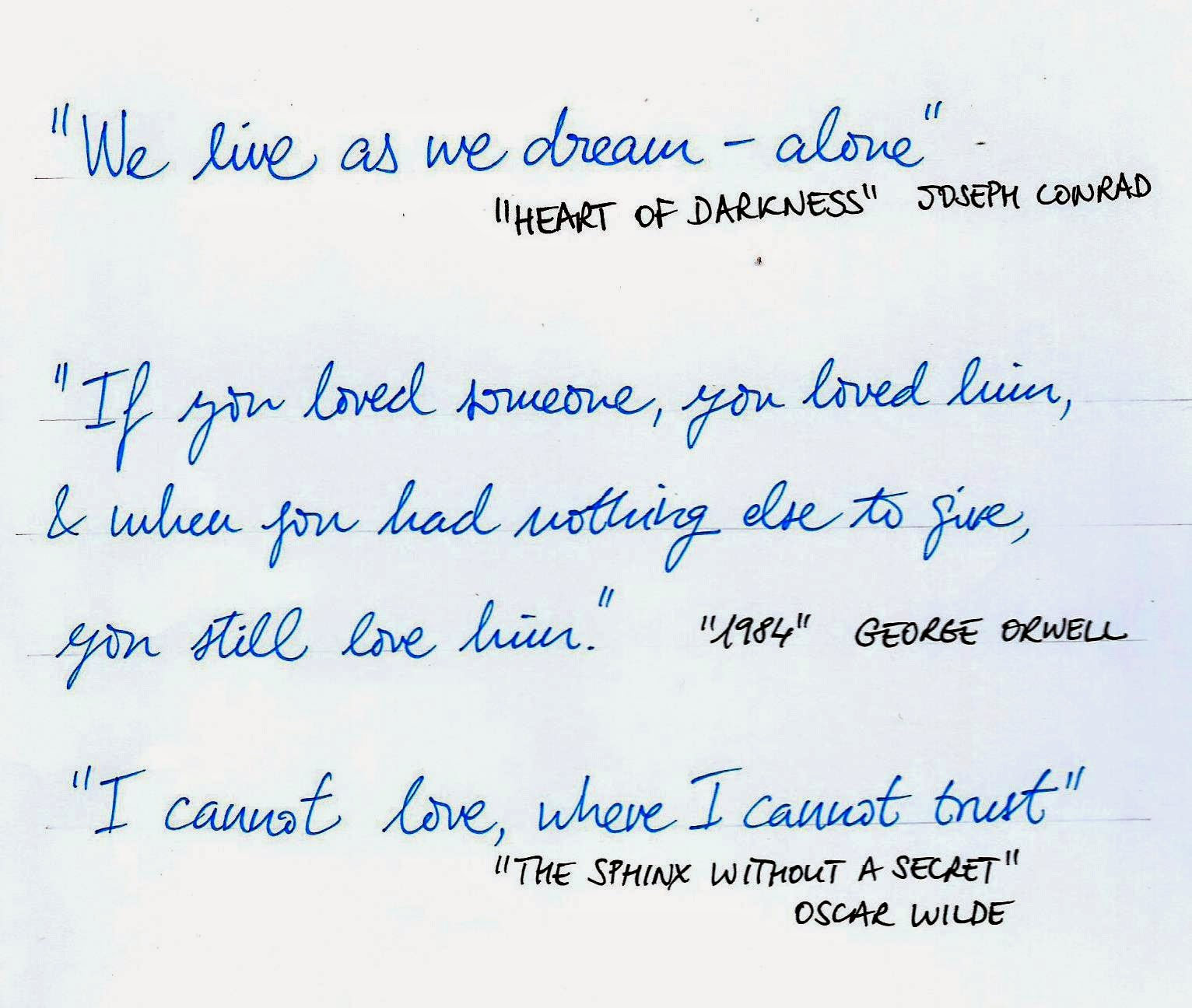
HANDWRITTEN QUOTES

 (6th Cultural Week-10: Writing in the 21st century)
One of the activities for this year's cultural week was HANDWRITTEN QUOTES IN ENGLISH. Here are some of the best we've found:

CAN YOU FIND SOME MORE...? HAND IN BEFORE WEDNESDAY, 22nd.

Monday, 13 April 2015

A BRIEF HISTORY OF WRITING ON VIDEO

 (6th Cultural Week-9: Writing in the 21st century)

Getting ready for this year's Cultural Week, here's a video in English with a brief history of writing from the British Museum.

Video:


Friday, 27 March 2015

VI CULTURAL WEEK POSTER & CONTESTS

Showing you for the first time the poster that announces our 6th Cultural Week devoted to the HISTORY OF HANDWRITING.
Also a reminder of what you can do to participate in the activities of this week.

1) In activities set by the English Department, check them HERE. (Your participation will be valued).

2) Or in the contests organized by the school's library:
- Emoticon contest.
- Pictogram contest.
- Stand up comedy monlogues.
- Quiz about the 100 Curiosities of the Spanish language.
- Creative writing contest.
- Musical reading and performance contest.
- Handwriting contest.
Check them all, HERE.

Participate in all or some of them, and bring you work after the Easter holidays. Deadline to hand in 22nd April.

The Cultural Week will be held between the 27th and 30th of April.


 (6th Cultural Week-8: Writing in the 21st century)

Monday, 16 March 2015

WRITING IN THE XXIst CENTURY: THE QWERTY KEYBOARD

 (6th Cultural Week-7: Writing in the 21st century)


Most of the writing we do in the XXIst century is done via a keyboard rather than using a pen or other means of handwriting. Keyboards available on old-fashioned typewriters and more modern uptodate computers, tablets or mobile phones.
Many people are surprised the first time they sit in front of a keyboard to see the strange way in which letters have been displayed and how this order has nothing to do with the alphabet.
The keyboard as we know it is called QWERTY, but its name doesn't come from its inventor, but for the first six letters starting from the left. The reason why they were disposed in this way is due to Christopher Sholes when he invented the first typewriter in 1868.
Trying to accomplish his invention, he placed each letter in alphabetical order in two rows, but he soon realised that, very frequently, the keys got stuck. He realised that this happened because some were more used than others, so he thought of displaying them at random, placing together letters of more, few and lesser use, what made it easier when typing without the mechanism getting stuck.
Since then, many other keyboards with perhaps more logical displays have been introduced, but the popularity of QWERTY's keyboard hasn't made them very successful.

Galician version of this post @ ArquivosDoTrasno.


Friday, 20 February 2015

WRITING IN THE XXIst CENTURY: A REMINDER OF THE PROJECTS PROPOSED BY THE ENGLISH DEPARTMENT FOR THE 6th CULTURAL WEEK

 (6th Cultural Week-6: Writing in the 21st century)

Here's a reminder of the projects we have proposed from the Department of English to participate in the 6th Cultural Week: The History of Handwriting. You can link from here to the original posts on this blog. You can participate in one, two... or all of them. The best will be exhibited and used as quizzes during the cultural week.


- PROJECT 1 - TEXT MESSAGING:
WRITE TEXT MESSAGES IN ENGLISH USING ABBREVIATIONS FOR OTHER STUDENTS TO DECODE INTO ENGLISH & ALSO TRANSLATE INTO GALICIAN/SPANISH.


PROJECT 2 - LITERARY HANDWRITTEN QUOTATIONS:
GIVE A HANDWRITTEN LITERARY QUOTATION IN ENGLISH OF A BOOK YOU'VE ENJOYED.


- PROJECT 3 - SMILEYS/EMOTICONS:
WRITE MESSAGES USING SMILEYS/EMOTICONS FOR OTHER STUDENTS TO DECODE INTO ENGLISH & ALSO TRANSLATE INTO GALICIAN/SPANISH.

- PROJECT 4 - TWEETS:
WRITE ORIGINAL OR FUNNY TWEETS IN ENGLISH. REMEMBER NOT MORE THAN 140 LETTERS. YOU MAY USE ABBREVIATIONS LIKE WHEN TEXT MESSAGING.


- PROJECT 5 - PICTOGRAMS:
a) CREATE YOUR OWN PICTOGRAMS. MAKE PEOPLE GUESS WHAT THEY MEAN. ANSWERS MUST BE SHOWN IN ENGLISH.

b) DO YOU KNOW ABOUT ANY OTHER SET OF PICTOGRAMS WIDELY USED? FIND OTHERS, THEIR MEANINGS MUST BE LATER GUESSED & WRITTEN IN ENGLISH BY OTHER STUDENTS.
This site is used with a non-profit educational purpose only. If you find content (photo/video...) you think shouldn't have been included here, please tell me so I can delete it. Thanks.

Blog labels / Tabs

'-ED' '-ING' 'S 1ºBac 1ºESO 2ºBac 2ºESO 3ºESO 4ºESO 8M 9/11 A(N) ABAU AS Abbreviations Ability Accents Adjectives Ads Adverbs Advicing Agreeing Agreement Alphabet Altkönigschule Animals Animation Anniversaries Antonyms Apologizing Apostrophe AprilFool Art Articles Aux.Verbs BBC BE BY Basics Behaviour Biography Blog Body BonfireNight BrE/AmE Bullying Business CINEMA COVID CV CW Carnival Causative Cause Celebration Christmas Cities CitySongs ClassActivity ClassrooManagement ClassroomLanguage Clothes Collocations Colours Commitment Communicating Comparatives Competition Compounds Conditionals Confusing Connectors ContinuousTenses Contractions Contrast ConversationAssist Cooking Coruña Cosmos Countability Crime Culture Curiosities DO Date Day Deduction Demonstratives Descriptions Design Determiners Directions ENOUGH EW19 Easter Emails Emphasis EngDepActivities EngEvolution EnglishWeek Environment Exams Exclamations F&AEssay FalseFriends Family Feelings Films Flashback Food Football Formal FrequencyAdvs Fun Functions Furniture Future GET GO Galicia Game Gastronomy Gender Genitive Geography Graduation Grammar Greetings Greta HAD BETTER HAVE Halloween HandwritingHistory Harassment Health Help tips Heritage History Home Homecoming Homographs Homophones Horoscopes Hull HumanRights Hygiene ICT Idioms Imperative Infinitive Info Informal Instruments Interjections Internet Introducing Inviting Ireland IrregularVerbs Jobs Karaoke Kron19 Kron23 Kron25 LIKE LanguageLearning Leisure Letterwriting Listening Literature Lockdown London LoveActually MAKE Maps Maths Measures Media Memories MindMap Mistakes ModalVerbs Money Multiculturalism Music MusicProject Narrative Nationalities NaturalDisasters Nature Negative News Numbers Nürn10/11 Nürn12 Nürn14 Nürn18 Obit Obligation Offering Onomatopoeias Opinions PASSWORD Paddington Palindrome Passive Past Peace Penpals PerfectTenses Permission Personality Philosophy Phoning Photography PhrasalVerbs Pioneers Plurals Poetry Politeness Politics Poll Possessive Possibility Practice Preference Prefix Prepositions Present PresentPerfect Press Prohibition Projects Promising Pronouns Pronunciation Punctuation Purpose QTags Quantifiers QuestionMaking Questionnaire Quiz Qwords RD25Years RafDieste Reading Reason Recipes Relatives RepVbs ReportedSpeech Requesting Retirement Routines Royals Scholarships SchoolActivities Science Scotland SeaSongs Secuencing Senses Shipwrecks Shopping Slang Sleep Slide Smileys SocialMedia Speaking Spelling Sport SportProject St.Patrick Storytelling Strategies Stress StudentExchange StudentPics StudentRecipes Suffix Suffragette Suggestions Sweets-cakes Symbols Synonyms THE THE SEA TV Teaching Technology Terrorism TheHoliday Theatre Thnksgvg-BlckFrdy Time Tools Traditions Translation Travel Tribute UK USA UsedTo Valentine Vehicles VerbTenses Verbs Videos Vocabulary Wales Wearing Weather Wellbeing Willstätter Wishing Women WordOrder Wordbuilding Writing vs €vision

PHONEMIC CHART

PHONEMIC CHART
Practice pronunciation