Here's a list of mistakes you should try to avoid:
8 Mistakes You Must Correct:
1
Problems with Subject-Verb Agreement
Some of the most painful things teachers have to hear are “she have”, “he don’t” or “people doesn’t”. Ouch! This is such a typical mistake. Because this is something you repeat and are used to repeating, you may “listen” to our correction but often don’t take the time to really let it sink in. If you are students who make the same subject-verb agreement mistakes, take the time to stop and really pay attention to it.
2
Incorrect Verb Tenses
These mistakes crop up again and again. If there’s one thing students need to focus on as they review for a test is the tenses they’ve learned, whether they are simple or advanced. Help by providing plenty of comparative charts – graphic organizers or timelines.
3
Missing or Extra Articles
Some students add an extra “the” when they shouldn’t (“The children play the Angry Birds.”) or omit an article that should be there (“I ate piece of toast for breakfast”). If you make lots of mistakes with articles, be sure to get a good review.
4
Repetitive Use of False Friends
Lots of languages, if not all, have “false friends” with the English language. For example,embarazada means “pregnant” in Spanish not “embarrassed” (and this confusion can make for some pretty funny classroom situations). There are examples like this one in many other languages. If you are students who resort to false friends, or even like to make up words, no matter how funny it may seem, you should try to use words you are sure are correct because you’ve learned them.
5
Pronunciation of Silent Consonants
If you have students who still pronounce the silent b in “comb” or “bomb”, you need to take a minute to write these down on the board and show them exactly which letters they need topronounce. The same goes for words like “Wednesday” (when the student pronounces the first d) or “muscle” (when the student pronounces the c as a “k”).
6
Speaking through Literal Translations
Everything seems to be going well in your classroom. Your students are very attentive and no one is speaking their native language. But then someone says, “I have 20 years.” If you, like this student, are also a native Spanish speaker, you’ll know for a fact your student just did a literal translation in his/her head. Students will do this, you can be certain of that, but it’s something you need to correct right away, lest they keep doing it.
7
Wrong Prepositions
This is one of the hardest mistakes to correct. There are so many uses for so many different prepositions, it’s hard for students to keep track of them all. One of the best ways to help out students who perpetually use the wrong preposition is to organize them into contexts, for example prepositions of place. We say we are “at school”, “at work”, “at home”, but “in the living room”, “in the bedroom” (“in” a particular room). We may also point out the difference between saying “at the bank” (in a bankingsituation) and “in the bank” (literally inside the building as opposed to outside).
8
Countable/Uncountable Mix-ups
Students in all levels will get countables and uncountables mixed up and incorrectly use “a little”, “a few”, “many”, “much”, etc… Again, charts and graphics are very helpful in this case, to help students see exactly what they’re doing wrong. You can use the classic two-column list to contrast (“a few cars” vs. “a little traffic”) or any of these strategies.
These are contractions mostly heard when speaking, but not usually seen in written speech (unless it's a transcription of spoken speech). Here are a collection of informal contractions, that is, contractions used in colloquial speech, never in formal or written situations. Informal use of English, when speaking with family and friends or texting/chatting on the internet.
Bringing you a song to sing along: "WHERE DID U GO?" by Midnight Red, an American boy band formed by Colton Rudloff, Joey Diggs Jr., Thomas Augusto, Eric Secharia & Anthony Ladao.
(6th Cultural Week-6: Writing in the 21st century)
Here's a reminder of the projects we have proposed from the Department of English to participate in the 6th Cultural Week: The History of Handwriting. You can link from here to the original posts on this blog. You can participate in one, two... or all of them. The best will be exhibited and used as quizzes during the cultural week.
- PROJECT 3 - SMILEYS/EMOTICONS: WRITE MESSAGES USING SMILEYS/EMOTICONS FOR OTHER STUDENTS TO DECODE INTO ENGLISH & ALSO TRANSLATE INTO GALICIAN/SPANISH.
a) CREATE YOUR OWN PICTOGRAMS. MAKE PEOPLE GUESS WHAT THEY MEAN. ANSWERS MUST BE SHOWN IN ENGLISH.
b) DO YOU KNOW ABOUT ANY OTHER SET OF PICTOGRAMS WIDELY USED? FIND OTHERS, THEIR MEANINGS MUST BE LATER GUESSED & WRITTEN IN ENGLISH BY OTHER STUDENTS.
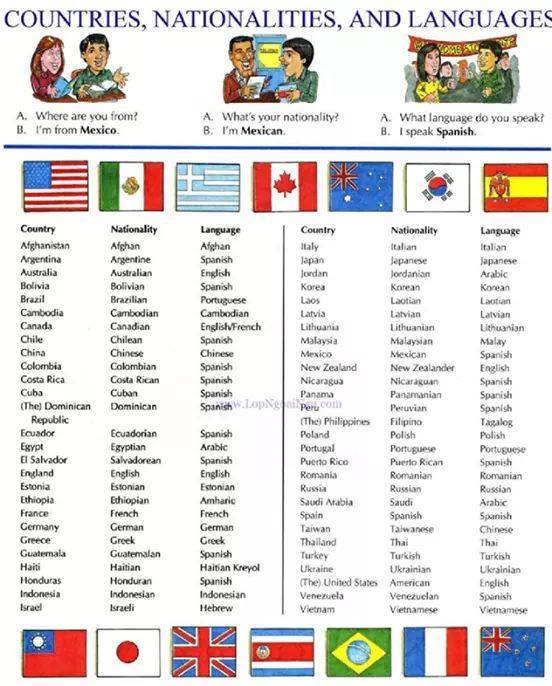
Using the suffixes below you can make the adjectives of nationalities. Check on the charts below some of the most common. There's also a link to an article about some English expressions with nationalities.
This site is used with a non-profit educational purpose only. If you find content (photo/video...) you think shouldn't have been included here, please tell me so I can delete it. Thanks.